Introduction
The headlong development of AI is driving a creative growth of Productive Forces and at the same time destroying existing relations of production and restructuring the mechanism of wealth distribution, with vast and far-reaching effects on economic and social development. To understand the path by which the mechanism of distribution is to be restructured in the age of AI, one must first be clear about the underlying logic of the distributive mechanism of industrial society—where its merits lie, where its defects lie, and how AI has systematically magnified those defects.
Part One: National Income and the Distribution of Wealth in Industrial Society
I. The Underlying Logic of the Market Economy and Its Mechanism of Distribution
1. The Dialectical Circulation of the Two Kinds of Production
The Industrial Revolution came together with the primitive accumulation of capital and turned labour-power into a commodity. Capital purchased labour-power and combined with wage labour to form the enterprise; enterprises produced goods and sold them to families; and thus the market economy and its mechanism of distribution were constructed.
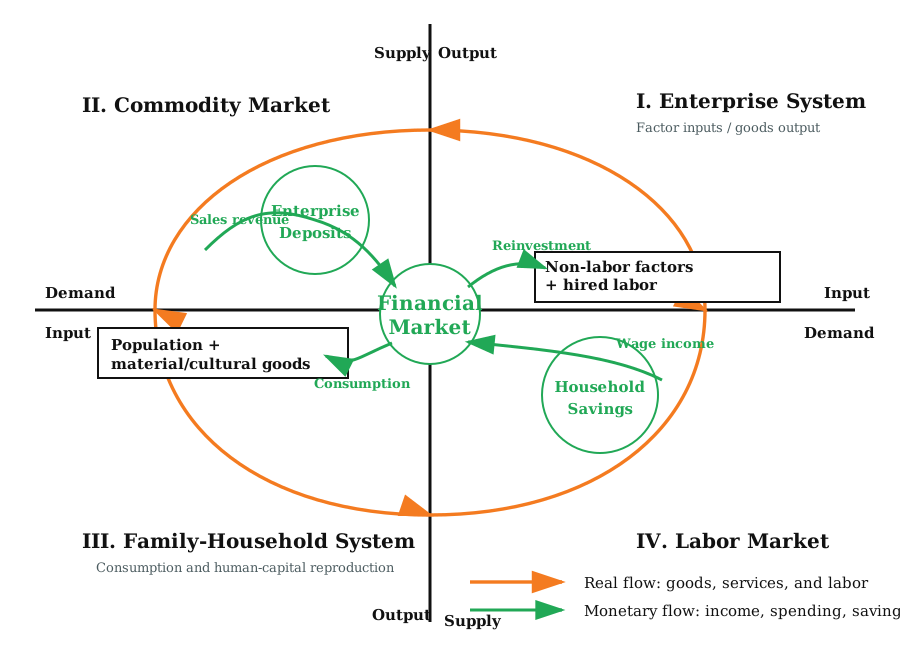
The underlying logic of the market economy is the dialectical circulation of the "two kinds of production" and the "two kinds of market", constructed by the family and the enterprise as two subjects of property rights (see Figure 1 on this website, the Diagram of the Dialectical Circulation of Two Kinds of Production). In the first quadrant, the enterprise system, composed of countless enterprises pursuing the maximization of profit, carries the function of producing the means of production and the means of subsistence and drives the development of Productive Forces. In the third quadrant, the family system, composed of countless families pursuing labour-income-based happiness maximization, carries the function of producing population and labour-power and drives the evolution of Life-Reproduction Capacity (shengmingli). The goods market of the second quadrant and the labour market of the fourth quadrant, with the circulation of money in the financial markets as their medium, connect the two kinds of production into an endless circuit.
2. Distribution According to Labour and Distribution According to Capital
The market leads the primary distribution of national income, pricing labour and capital with money as the unit of account, and follows the principles of distribution according to labour and distribution according to capital. The basis of market distribution is property: ownership of labour-power constitutes the property basis of distribution according to labour, and ownership of capital constitutes the property basis of distribution according to capital.
Value is not price. Returns to property are finally formed in the competition of supply and demand in the market: supply and demand in the employment market determine the rate of employment and the level of pay, and so price labour-power; supply and demand in the goods market determine enterprise profits and the accumulation of capital, and so price capital.
Distribution according to capital rewards the creativity, the managerial talent, and the risk-bearing capacity of entrepreneurs and investors, with profit as its core motive force. Distribution according to labour rewards workers for their exertion, with wages and salaries as its core motive force. The two are "twins" in a unity of opposites and mutual dependence; the deeper motive force behind them is the trading of property rights and the game of interests between the two camps of capital and labour and within each of them—and the outcome of that game is often unequal. Since the 1970s the rate of return on capital, the capital share of income, and the labour share of income in a number of major developed economies have displayed trends favourable to the accumulation of capital and the concentration of wealth, confirming this structural inequality.[1]
3. Market Failure: The Vexed Question of Fairness and Efficiency
The market economy is a system of wealth creation and distribution marked by "equality of competitive opportunity and inequality of competitive outcome". Within it there has always been a great question that has vexed human society: which matters more, fairness or efficiency? The question is so momentous that it has given rise to two opposed ideologies: capital, valuing efficiency, gave birth to capitalism; labour, valuing fairness, developed socialism.
The causes of inequality in the distribution of wealth are hidden in the structure by which property rights are allocated. The first is the unequal allocation of labour-power as embodied human capital. The second is the unequal allocation of the ownership and the control of capital—the entrepreneurs who control capital hold the upper hand in bargaining with the salaried classes, reinforcing a distributive pattern of "capital strong, labour weak", in which the growth of pay fails to keep up with the growth of profit.
Yet inequality in the distribution of income is, in the long run, bad for enterprise capital as well. When profits grow faster than pay, enterprises overproduce while families under-consume, and carried far enough this is economic crisis—the deficient effective demand that Keynes identified in the Great Depression is precisely the concentrated expression of this endogenous contradiction.[2]
Two lessons follow. First, capital and labour are a community of shared destiny in a unity of opposites. Second, the most desirable system of distribution is one that can attend to efficiency and fairness together and secure a virtuous circulation of the "two kinds of production". The market economy cannot achieve that balance spontaneously—this is an inherent defect, endogenous to the market economy and not to be overcome within it, and it must be made good by the government's mechanism of distribution.
II. Government Functions and "Distribution through State Power"
Government leads the redistribution of national income, and its essence is "distribution through state power": relying on the coercive power of the state apparatus, government forms state-owned assets and state capital by means of taxation, and produces and supplies public goods through fiscal instruments.
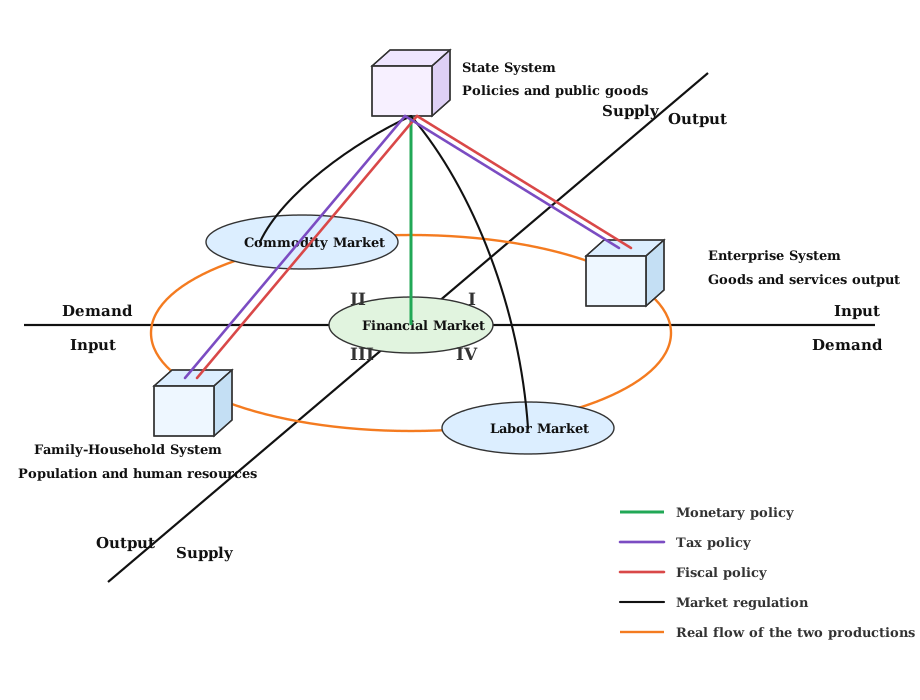
The government mechanism and the market mechanism—distribution through state power plus distribution according to labour plus distribution according to capital—together constitute a market economy under government regulation, and form an economic and social ecosystem in which the "three kinds of production"—goods, population and labour-power, and public goods—are mutually reinforcing (see Figure 2 on this website, Diagram 2: The Grand Tripartite—Asymmetrical Configuration and Checks and Balances among Family-Household Rights, Enterprise Rights, and Government Power). Wherever government and public goods are involved, there is no such thing as a "pure market economy".
III. Distribution According to Need: Its Definition and the Mechanism by Which It Is Formed
1. Distribution According to Need Is Not "Distribution According to Desire"
Determined as it is by human nature, individual desire is unlimited and never satisfied; distribution according to desire is therefore forever impossible. Desire has no price and cannot be measured in money; yet individual desire is the ultimate motive force of social development and its living wellspring.
Extended from the individual to the collective organization, desire gives rise to the desires of organizations: families pursue labour-income-based happiness maximization; enterprises pursue the maximization of profit; government pursues the maximization of Government Power. These three desires contradict and constrain one another and reach a balance through the game of supply and demand, each curbing the excess of the others and marking out the boundaries of the three parties' demands. These are the dynamic boundaries of the "three great needs".
2. Distribution According to Need in a Form That Can Be Put into Practice: A Balance among the Effective Demands of the Three Parties
The "three great needs" correspond to "three great supplies", and this determines that distribution according to need has three components.
The effective demand of family consumption: to obtain income from pay, and to purchase the material and spiritual means of subsistence necessary for population procreation. The level of income from pay regulates the boundary of family effective demand.
The effective demand of enterprise production: the accumulation of profit and the investment of capital, and the purchase of the factors of production required for reproduction. The scale and speed of profit and of capital accumulation constitute the boundary of enterprise effective demand.
The effective demand of government governance: the building, on the basis of taxation and public finance, of the organizational apparatus, the leadership, and the governing capacity required to produce public goods. The level and the structure of taxation mark out the boundary of government effective demand.
Core judgment: distribution according to need in a form that can be put into practice, realized, and institutionalized is the organic combination of distribution according to labour, distribution according to capital, and "distribution through state power". It is the institutional guarantee that contains a competitive mechanism within it, that pursues a balance among the "three great supplies and demands", and that secures a virtuous circulation of the "three kinds of production". Money and the circulation of money are indispensable instruments for realizing the distribution of national income and wealth; their nature as credit, and their function as the medium of exchange and of distribution, will not disappear because the form of technology changes.
Part Two: AI's Overturning of the Distributive Institutions of Industrial Society
IV. The AI Shock: "Productive Forces Running Ahead, Life-Reproduction Capacity Lagging Behind"
1. AI Is Overturning the Existing Structure of Distribution
The disorderly development of AI magnifies inequality in market distribution and may set off an economic crisis compounded by a social crisis. A dangerous social tendency is taking shape: AI is encroaching on workers' jobs on a large scale and throwing supply and demand in the employment market out of balance—on the demand side the aggregate contracts while its structure is unknown; on the supply side there is aggregate surplus and structural mismatch.
Key figures:
- USD 13 trillion: the additional global economic output that the McKinsey Global Institute estimates AI may deliver by 2030 (McKinsey Global Institute, 2018)
- 300 million: the number of full-time jobs worldwide that Goldman Sachs estimates AI may affect (Goldman Sachs, March 2023)
- 170 million and 92 million: the World Economic Forum projects that some 170 million new jobs will be created worldwide between 2025 and 2030 while some 92 million are displaced, a net increase of about 78 million. The real danger lies not in "the total number of jobs falling to zero" but in a violent recomposition of the structure of jobs, the structure of income, and bargaining power (WEF, 2025)
- The top 1 per cent: the richest 1 per cent of the world's population own about 43 per cent of global financial assets (Oxfam, January 2024)
- USD 109.1 billion: private AI investment in the United States in 2024, about twelve times that of China; global private investment in generative AI was about USD 33.9 billion, an increase of 18.7 per cent on the previous year—which shows that AI capital is becoming highly concentrated in a few countries and a few platform enterprises (Stanford AI Index, 2025)[12]
2. "Distribution According to Computing Power": A New Distributive Alienation in the Age of AI (an original concept)
AI overturns the structure of the primary distribution of national income on at least four levels.
First, it overturns distribution according to labour. Where work is lost and the opportunity to labour is gone, what is there to distribute according to labour? A wave of mass unemployment will produce the social phenomenon of "labour-power that has value but no price—a price of zero", forming a "thrombus" in the sphere of distribution.
Second, it reshapes distribution according to capital and gives rise to "distribution according to computing power". Capital drifts rapidly towards computing power and algorithms, and out of this comes distribution according to computing power. Computing power and algorithms become instruments monopolized by a very few super-large companies, and instruments by which they amass wealth on a vast scale. On one side the aggregate of wealth grows at an accelerating rate; on the other the distribution of wealth grows unbalanced at an accelerating rate.[3]
An explanation of the concept of "distribution according to computing power": distribution according to computing power is an original concept advanced in this essay. It denotes a mode of distribution in which those who control computing power, algorithms, and data obtain excess distributive returns through their monopoly of these three new factors of production. Its fundamental difference from traditional distribution according to capital is this: the scale effects of traditional capital have physical boundaries; algorithms and digital products have low costs of replication and strong scale effects, while computing power, energy, advanced chips, and high-quality data remain constrained by physical and institutional bottlenecks. It is precisely the combination of replicability at the digital layer with scarcity at the physical layer that makes it easier for those who control critical computing power to form a winner-takes-all pattern of monopoly.
Third, it redefines the concept of the enterprise. AI compresses the transaction costs between the property rights of capital and the property rights of labour towards zero (the limiting case of the Coase theorem),[4] so that distribution according to labour and distribution according to capital may merge into one, and the property basis and the distributive pattern of the primary distribution of national income are thereby fundamentally altered.
Fourth, AI brings about an equalization of access to knowledge, but magnifies the gap in capability. The inherent defect of the market mechanism—"equality of competitive opportunity and inequality of competitive outcome"—is magnified sharply by AI, at exponential speed.
3. The Perspective of Monetary Circulation: How the Spiral Trap Is Formed
Analysed at the level of monetary circulation, the spiral trap of Productive Forces Running Ahead, Life-Reproduction Capacity Lagging Behind becomes clearer still: pay falls in the labour market of the fourth quadrant → the purchasing power of families in the third quadrant becomes insufficient → the supply of means of subsistence exceeds demand in the second quadrant → funds in the first quadrant circulate idly in the financial markets, producing deflation, which appears in the real economy as a spiral contraction of the "two kinds of production".
4. AI's Intellectual Property Belongs to All Humanity: The Juridical Basis of Distribution According to Need
By property-rights theory, whoever controls AI holds the key to the distribution of AI's wealth. But AI is in essence the gathering, the refining, and the recombination of the knowledge humanity has already accumulated over thousands of years—knowledge that is an inheritance of civilization built up in common by generation after generation of all humanity, and not the private property of any single subject. AI brings together the sum of humanity's knowledge; its intellectual property ought, as a matter of legal principle, to belong to all humanity, and AI ought to be a public good for the benefit of all humanity rather than a monopoly of a few large technology firms.[5]
This is the fundamental juridical ground of this essay's propositions of "raising the weight of government distribution through state power" and "state equity participation in AI companies".
Part Three: Institutional Reconstruction—Building a Mechanism of Distribution According to Need That Can Be Put into Practice
V. Raising the Weight of Government "Distribution through State Power"
1. The Government's Motive: The Inner Unity of the Maximization of Power and Fair Distribution
Whatever the institutional model, the foundation of Government Power is social stability and order. The gulf between rich and poor leads to economic crisis; economic crisis sets off social crisis; social crisis threatens the stability of power. This is the fundamental logic by which government possesses an intrinsic motive to eliminate the gap between rich and poor.
2. Six Concrete Measures by Which Government May Respond to the AI Crisis
Measure One (short term): direct cash payments to households
To draw off, in moderation, the surplus funds in the sphere of enterprise production and pay them instead to households in order to expand consumption is the simplest, the most direct, and an effective way of relieving the crisis of Productive Forces Running Ahead, Life-Reproduction Capacity Lagging Behind. International experience: Finland's universal basic income experiment of 2017–2018 (EUR 560 a month, with 2,000 unemployed people taking part) reported in its final evaluation that recipients had higher life satisfaction and lower mental strain, while the effects on employment were small.[6]
Measure Two (long term): establish a national sovereign wealth fund and advance a universal shareholding scheme
A point of reference: Norway's Government Pension Fund Global (about USD 1.7 trillion at the end of 2024, the largest sovereign wealth fund in the world) converts oil revenue into an asset of the whole population, and every Norwegian citizen theoretically holds a share of about USD 300,000.[7] A similar logic can be applied to the AI dividend. AI is not oil: oil is a rent on a natural resource, whereas AI is an institutional rent formed jointly by data, computing power, algorithms, accumulated knowledge, and the organization of capital. The key to an AI sovereign wealth fund is therefore not simply to "take it into state ownership", but to convert part of the AI dividend—supported as it is by public knowledge, public education, public infrastructure, and social data together—into a public asset that can be audited, that can pay dividends, and that can accumulate across generations.
Measure Three (tax system): introduce a tax on computing power and an AI substitution tax
Super-large AI companies, and the super-individuals who use AI on a large scale, generate—as environmental pollution does—an effect of "returns internalized, costs spilled over". The mass unemployment AI causes is a social cost spilled over by AI, and it must be borne by AI's users through the payment of a social-security tax. International progress: the European Union passed the Artificial Intelligence Act in 2024; and the idea of legislating for a "robot tax" has entered public-policy discussion.[8]
Measure Four (employment): open new fields of work in the public sphere
In such domains as the response to global warming, environmental protection, care in an ageing society, and basic scientific research, open up entirely new fields of work and create new jobs, and build a "reservoir for the circulation of labour" that covers society as a whole.
Measure Five (industry): support in every dimension the new forms of employment AI creates
Attend to and support, as a matter of strategy, the new jobs, the new trades and industries, and the new forms of employment that the market mechanism and the development of AI create naturally.
Measure Six (strategy): state equity ownership, or state equity participation, in core AI companies
An analysis of the benefits and the costs.
Benefits: it ensures that part of the AI dividend flows back to all citizens; it gives government a substantive voice in the direction of AI's development; it provides a stable source of funds for universal basic income or for a sovereign wealth fund; and it prevents a monopoly of computing power from deepening the polarization between rich and poor.
Costs: the government bureaucracy may suppress the vitality of AI innovation; political intervention may distort AI's technological path; capital flight may be set off; legal challenges may arise in democratic countries; and "representing the public interest" may degenerate into a banner for "representing the interests of the governing group".
The judgment of this essay: full nationalization is not to be recommended; equity participation rather than control, and regulation rather than operation, is the more realistic path. Government may hold a minority stake in core AI companies (say 10–20 per cent), acquiring rights to dividends and seats on the board, without entering into decisions of day-to-day management. The Norwegian government's shareholding in its national oil company, and Temasek's shareholdings in a number of strategic enterprises in Singapore, are cases in point.
International currents: in June 2026 proposals for public shareholding, an AI sovereign wealth fund, and equity sharing had already appeared in United States policy discussion. Senator Bernie Sanders advanced the idea of letting the public share in the equity returns of large AI enterprises by way of a sovereign wealth fund; Dario Amodei, the chief executive of Anthropic, likewise listed universal basic income, capital gains taxation, sovereign wealth funds, and equity sharing among the possible policy instruments when discussing AI's impact on employment; and media reports have said that the Trump administration too is attentive to the idea that the AI giants should give something back to the public interest in some form.[10][11] These currents must not be described as an established institution, still less simply equated with "the state has already taken equity stakes in AI companies". Their significance is that the making public of the returns to AI capital has moved from the margins of thought into mainstream policy discussion.
Question from an adversarial reviewer: can state equity participation in AI companies genuinely represent Family-Household Rights, rather than enlarge an alliance between Government Power and enterprise privilege? How is state equity ownership to avoid becoming an instrument by which government picks winners, by which crony capital extracts rents, or even an instrument of technological nationalism? If these questions cannot be met with institutional constraints, "distribution through state power" may slide from an instrument for correcting market imbalance into a new monopoly of power.
VI. Global AI Governance: Taking the Mechanism of the Nuclear Non-Proliferation Treaty as a Reference
The risk of AI's proliferation resembles that of nuclear weapons in certain respects: once the technology has spread it is hard to take back; its potential destructive power exceeds the control capacity of any single state; and it can be managed effectively only through global coordination.
The Treaty on the Non-Proliferation of Nuclear Weapons (NPT), signed in 1968, offers an imperfect but genuinely effective point of reference: against the background of geopolitical antagonism between the United States and the Soviet Union in the Cold War, the two superpowers still reached a limited consensus on nuclear non-proliferation, and by that treaty assigned the task of verification and safeguards to the already existing International Atomic Energy Agency (IAEA).[9]
What the NPT model suggests for global AI governance: an agreement setting a ceiling on AI capability; an international AI safety agency; a distinction between "civilian AI" and "military AI", with stricter control over the latter; and mechanisms for reporting AI incidents and sharing information.
Important differences: AI spreads far faster than nuclear technology; AI has both military uses and wide civilian value, so that the boundary of control is harder to draw; and the intensity of present AI competition between the United States and China may exceed that of the US–Soviet nuclear competition of the Cold War, which makes consensus harder to reach.
The possibility of a minimum consensus: even if no comprehensive agreement can be reached, there may still be room for limited consensus among the major powers on such baseline questions as "AI must not be used to decide autonomously on weapons of mass destruction" and "AI systems must remain under ultimate human control".
VII. The Cooperative Game: The Ideal of Distribution According to Need under "the Mechanism of the Separation of and Checks and Balances among the Grand Tripartite"
The distribution of wealth in human society is achieved through competition in real life—between person and person, institution and institution, organization and organization. There exists no superhuman "hand of God" to arrange "distribution according to desire" with objectivity and justice.
Competition divides into the cooperative game and the non-cooperative game. A cooperative game is competition on the basis of rules governed by the rule of law and of information transparency, and it aims at a shared win achieved through competition; a non-cooperative game rests on the participants' strength, and even on force, and pursues a winner-takes-all outcome. A cooperative game increases the likelihood of a three-way win, whereas a non-cooperative game increases the likelihood of a three-way loss.
The central demand of the mechanism of the separation of and checks and balances among the Grand Tripartite is to secure a rational configuration of rights and power: to confer, by way of the rule of law, rights that are sufficient but bounded on families and individuals, rights that are sufficient but bounded on enterprises, and power that is sufficient but bounded on government. The three are mutually reinforcing and mutually constraining; through a cooperative game they satisfy the needs of the three parties and drive a virtuous circulation of the "three kinds of production". This is the ultimate ideal of distribution according to need under the mechanism of the separation of and checks and balances among the Grand Tripartite.
Viewed worldwide, human society has not yet built an effective world government, and the distribution of wealth on a global scale therefore remains, over the long run, within the logic of a non-cooperative game. If a world government could be established that accommodated many civilizations and institutional models and possessed sufficient authority, that could supply public goods to all humanity and realize a cooperative game on a global scale, then human society would enter a "Heheist society", and distribution according to need could be truly realized for human society as a whole. Regrettably, this remains a fine but distant aspiration. Even so, the direction is clear: every step that advances the cooperative game, and every step that improves the mechanism of checks and balances among the Grand Tripartite, is a step nearer that goal.
Conclusion: Distributive Justice Is the Greatest Political Question of the Age of AI
The core conclusions of this essay may be put in three sentences.
First, AI has greatly raised Productive Forces; but without institutional intervention its dividend will be concentrated, by the logic of distribution according to computing power, in the hands of a few computing-power elites, aggravating rather than relieving the polarization between rich and poor.
Second, this distributive defect cannot be made good by the market's spontaneous repair alone. An institutional force with public binding authority must be brought in—raising the weight of "distribution through state power" and using such institutional instruments as universal basic income, a tax on computing power, sovereign wealth funds, state equity ownership or state equity participation in AI companies, and a global framework of AI governance, in order to convert part of the AI dividend into a dividend for the whole population.
Third, the fundamental juridical ground of all this is that AI brings together the knowledge already accumulated by all humanity; its property rights should, as a matter of legal principle, belong to all humanity, and it ought to be a public good for the benefit of all humanity rather than an instrument of private monopoly in the hands of a few large technology firms.
"Life-Reproduction Capacity takes primacy over Productive Forces"—the distribution of wealth in the age of AI must take as its priority the safeguarding of the continued procreation and development of family Life-Reproduction Capacity, and not take the maximization of the efficiency of capital accumulation as its sole standard. Distributive justice is the greatest political question of the age of AI.
Musk's judgment that AI and robotics may make money "irrelevant" raises a further major proposition for the age of AI: when Productive Forces move towards extreme abundance, will money, prices, and the institutions of distribution undergo a fundamental restructuring? This website will treat that question in a separate article.[13]
Notes
- T. Piketty, Capital in the Twenty-First Century (Belknap Press of Harvard University Press, 2014).
- J. M. Keynes, The General Theory of Employment, Interest and Money (Macmillan, 1936).
- Bloomberg Markets, Nvidia market-capitalization data, November 2024; Nvidia annual report, 2024.
- R. H. Coase, "The Nature of the Firm", Economica 4, no. 16 (1937): 386–405.
- European Union, the Artificial Intelligence Act: passed by the European Parliament in March 2024, finally approved by the Council of the European Union in May 2024, and in force from August 2024; and the associated discussions on copyright-law reform, 2023–2024. The material listed here records developments in regulation and in the debate on copyright-law reform. Existing law has not established any collective right of humanity to AI-related intellectual property; that is a normative proposition advanced in this essay.
- O. Kangas et al., The Basic Income Experiment 2017–2018 in Finland (Ministry of Social Affairs and Health, Finland, 2020).
- Norges Bank Investment Management, Annual Report 2024.
- European Parliament, the AI Act, March 2024; Bill Gates's interview on a robot tax, Quartz, 2017.
- Treaty on the Non-Proliferation of Nuclear Weapons (NPT), 1968.
- Office of Senator Bernie Sanders, "Sanders Introduces Legislation to Create $7 Trillion AI Sovereign Wealth Fund", 18 June 2026; associated policy reporting, June 2026.
- Associated Press, "Anthropic pledges $200 million to research AI's economic impact as CEO suggests job loss solutions", June 2026.
- World Economic Forum, "The Future of Jobs Report 2025", January 2025; Stanford University, "Artificial Intelligence Index Report 2025", April 2025.
- Times of India, "World's first trillionaire Elon Musk explains why AI will make money useless", June 2026; Business Insider, "Elon Musk says AI and robotics will make money 'irrelevant'", November 2025.
- Further reading. See also: P. Van Parijs and Y. Vanderborght, Basic Income (Harvard University Press, 2017); G. Standing, The Precariat (Bloomsbury Academic, 2011); D. Acemoglu and S. Johnson, Power and Progress (PublicAffairs, 2023); World Economic Forum, "The Future of Jobs Report 2025"; Stanford University, "Artificial Intelligence Index Report 2025".